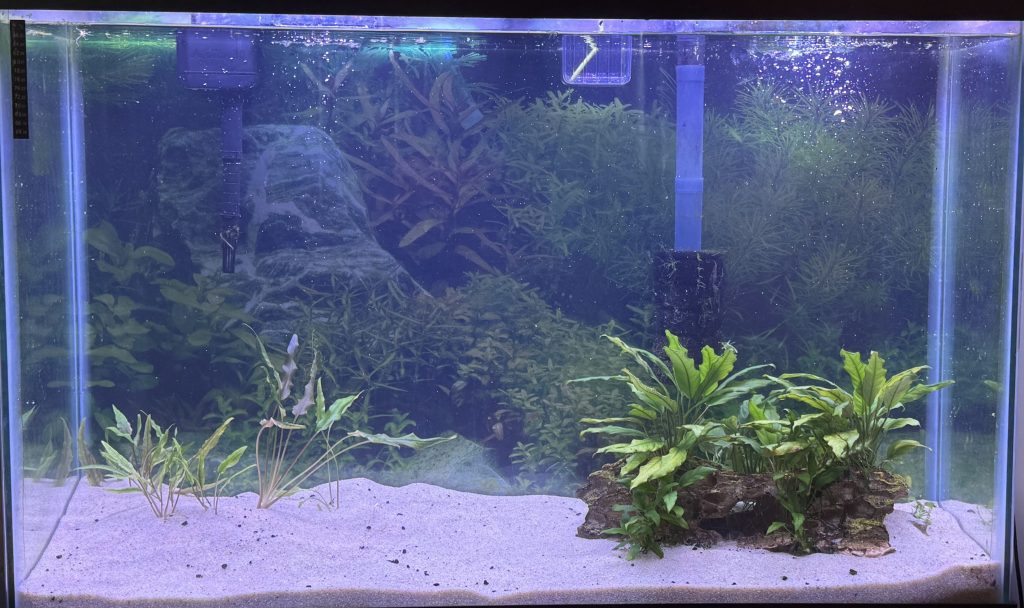
Aquariums are a relaxing and enjoyable hobby. Watching the fish swim through crystal-clear water, forage for food, and interact with each other is a lot of fun! However, there is a lot that goes into setting up an aquarium correctly. When learning the basics, new fish keepers often find it helpful to stock their aquariums with hardy fish that are easy to take care of.
From bettas and tetras to mollies and the cutest catfish you’ve seen in your life, there are plenty of beautiful species that are forgiving toward beginner mistakes.
Before we dive into this list of fish that are easy to take care of, let’s talk about what it means for a fish to be “beginner-friendly.”
What Makes a Fish 4″Beginner-Friendly”?
I’ve carefully compiled this list using my own experience as a fish keeper and pet store employee, real-world conversations I’ve had with beginner and advanced aquarists, and lots of research. The criteria I’ve used to make this list are as follows:
- Ability to tolerate minor fluctuations in water chemistry (temperature, pH, and nitrogen compounds)
- Minimum tank size requirements
- General health in the pet trade
- Compatibility with tank mates
Some fish touted as “beginner-friendly” do not fit these requirements. For example, fancy guppies were once considered easy, hardy fish. However, the guppies most readily available (those in chain pet stores) are often sickly and inbred, requiring a very stable environment–and sometimes medication–to thrive. I’ve had fish owners do everything “right,” but their guppies still die. For this reason, fancy guppies did not make the list.
Table of Contents
- What Makes a Fish 4″Beginner-Friendly”?
- Table of Contents
- Best Solitary Fish for Beginners
- Best Schooling Fish for Beginners
- Zebra Danio (Danio rerio)
- Skirt Tetras (Gymnocorymbus ternetzi)
- White Cloud Mountain Minnow (Tanichthys albonubes)
- Rosy Red Minnow/Fathead Minnow (Pimephales promelas)
- Cherry Barb (Puntius titteya)
- Harlequin Rasbora (Trigonostigma heteromorpha)
- Glowlight Tetra (Hemigrammus erythrozonus)
- Black Neon Tetra (Hyphessobrycon herbertaxelrodi)
- Best Livebearers for Beginners
- Best Bottom Feeders and Algae Eaters for Beginners
- Frequently Asked Questions
- Conclusion
Fish That Are Easy To Take Care Of
There are a lot of fish that are good for beginners. To help you find your way, I’ve divided them into categories: solitary fish, schooling fish, livebearers, and the clean-up crew.
Best Solitary Fish for Beginners
If you want just one fish in your aquarium to let yourself get the hang of things, the following species are great choices. They will fight with others of their kind, and they thrive in solitude.
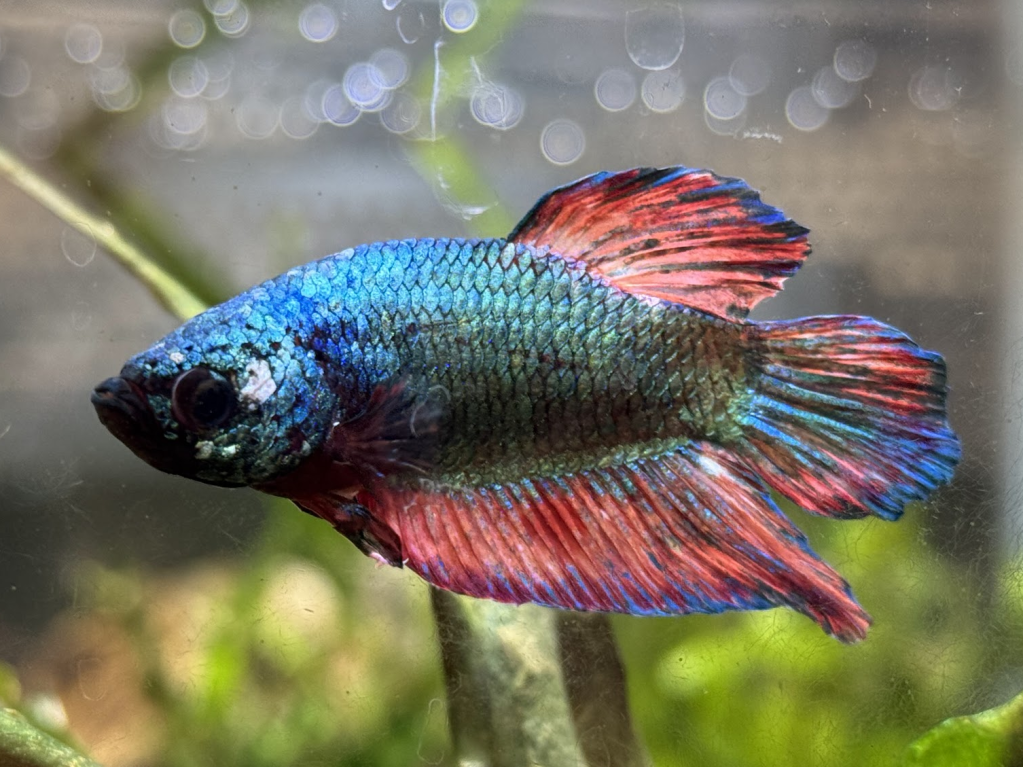
Bettas (Betta splendens)
Bettas, also known as Siamese fighting fish, are a popular fish for first-time fish owners. They are hardy, colorful, and they don’t need massive tanks or friends. As long as you provide an adequately sized tank and warm, clean water, your betta should do just fine!
- Minimum tank size: 5 gallons (~20L)
- Temperature range: 75-82° F (~24-28° C)
- Max Size: 3 inches (7.62 cm)
- Temperament: aggressive
- Social needs: best kept alone
Best Schooling Fish for Beginners
The following fish are schooling, which means they like to live in groups! I recommend the following species in groups of 6 or more. If there are too few individuals in a school, they will not feel safe, resulting in your fish hiding and being stressed, making them more likely to get sick. Some schooling fish will also become violent if they don’t have enough friends to harass.
Zebra Danio (Danio rerio)
The zebra danio is one of the most popular aquarium fish for beginners. These zippy little guys are active and hardy. They have a large temperature range, and they are even used in scientific research! They come in short-finned and long-finned varieties, as well as gold and leopard. Some have even been modified with jellyfish DNA (GloFish) and are just as hardy as their unmodified cousins.
- Minimum tank size: 10 gallons (~40 L)
- Temperature range: 65–78°F (~18–25.5°C)
- Max Size: 2 inches (5 cm)
- Temperament: peaceful
- Social Needs: schooling (6+)
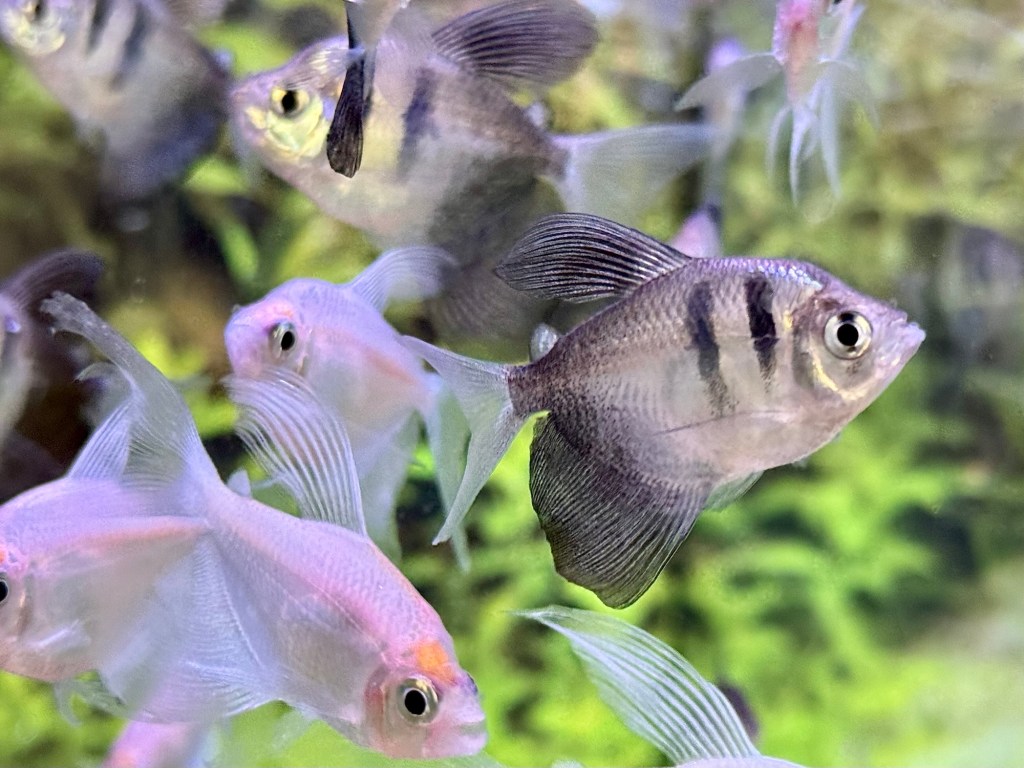
Skirt Tetras (Gymnocorymbus ternetzi)
Skirt tetras are another species that I recommend for your first aquarium. While they do get a little larger than zebra danios and need at least a 20-gallon tank for a school, they are worth it. Their larger size make them easier to see from far away. They come in several varieties, including long- and short-finned, black skirt, white skirt, and Glo-ified. All of the flavors can be mixed together for a beautiful, diverse school!
- Minimum tank size: 20 gallons (~76 L)
- Temperature range: 75-80° F (~24-27° C)
- Max Size: 3 inches (7.62 cm)
- Temperament: peaceful
- Social Needs: schooling (6+)
White Cloud Mountain Minnow (Tanichthys albonubes)
If you’re looking for a small fish for a coldwater aquarium, check out the white cloud mountain minnow! They are easy to care for and don’t require a heater in the standard home. Both standard and gold white clouds have a brilliant white stripe down their sides and adorable red fins.
- Minimum tank size: 10 gallons (~40 L)
- Temperature range: 65–75°F (~18–24°C)
- Max Size: 1.5 inches (4 cm)
- Temperament: peaceful
- Social Needs: schooling (6+)
Rosy Red Minnow/Fathead Minnow (Pimephales promelas)
Frequently sold as feeder fish or as bait, fathead minnows are another hardy fish for a coldwater aquarium. Whether you opt for the silvery wild-types or the pink-toned rosy reds, they can cohabitate with white clouds and zebra danios for a thriving community tank.
- Minimum tank size: 20 gallons (76 L)
- Temperature range: 50-70° F (~10-21° C)
- Max Size: 3.5 inches (9 cm)
- Temperament: peaceful
- Social Needs: schooling (6+)
Cherry Barb (Puntius titteya)
These peaceful barbs get their name from the vibrant red color sported by mature males. Females are more of an orange-ish brown. While many fish keepers want to have a school made up of cherry-red fish, having a mixed-sex group will encourage brighter colors as the boys try to show off for the ladies.
- Minimum tank size: 20 gallons (80 L)
- Temperature range: 75-80° F (~24-27° C)
- Max Size: 2 inches (5 cm)
- Temperament: peaceful
- Social Needs: schooling (6+); 2F:1M
Check out the video below to learn more about these stunning fish!
Harlequin Rasbora (Trigonostigma heteromorpha)
Harlequin rasboras are another fish that are easy to take care of. These adorable, half-black fish stay small and get along with many other species. Some keepers claim that they are one of the hardiest fish in the aquarium trade, potentially living over 5 years with proper care.
- Minimum tank size: 10 gallons (40 L)
- Temperature range: 72-80°F (~22-27°C)
- Max Size: 2 inches (5 cm)
- Temperament: peaceful
- Social Needs: schooling (6+)
Glowlight Tetra (Hemigrammus erythrozonus)
The glowlight tetra is a striking fish with a stunning, bright orange stripe running down its silvery sides. If you are looking for some subtle pops of color that rival the electric blue of the more popular neon tetra, a school of glowlights might be just what your are looking for!
- Minimum tank size: 10 gallons (40 L)
- Temperature range: 75-80°F (~24-27°C)
- Max Size: 2 inches (5 cm)
- Temperament: peaceful
- Social Needs: schooling (6+)
Black Neon Tetra (Hyphessobrycon herbertaxelrodi)
Despite their name, black neon tetras are not super closely related to the standard neon tetra, but they are another beginner-friendly fish that will liven up your aquarium, despite their understated colors. They are also larger, bolder, and hardier than neon tetras, making them suitable tankmates for a variety of species.
- Minimum tank size: 10 gallons (40 L)
- Temperature range: 72–80°F (~22–27°C)
- Max Size: 2 inches (5 cm)
- Temperament: peaceful
- Social Needs: schooling (6+)
Best Livebearers for Beginners
Livebearers get their name because, unlike many other fish, they give birth to live young! While it is super cool to watch, and livebearers are a great introduction to fish breeding, I recommend that new fish keepers only keep one sex–all males or all females. This is because livebearers can quickly overpopulate your tank. When you pick out your fish, ask the fish store employee pick out one sex. It’s important that you also learn how to tell the difference between male and female livebearers so that you can double-check.
If you do decide to keep a mixed group and are prepared for loads of babies, keep 2-3 females for every male. If keeping a same-sex group, aim for at least 3 individuals to disperse any bullying, with 5+ fish being ideal.
Endler’s Livebearer (Poecilia wingei)
The Endler’s livebearer is the fancy guppy’s smaller, hardier cousin. Endlers have a greater tolerance to shifts in water parameters like temperature, and they are less susceptible to disease, making them a great alternative to fancy guppies in the beginner aquarium. While the females are often colorless, the males can display some dazzling hues.
- Minimum tank size: 10 gallons (40 L)
- Temperature range: 65-80°F (~18-27°C)
- Max Size: 1 inch (2.5 cm) for males
- Temperament: peaceful
- Social Needs: groups of 3+
Check out the video below (by the one-and-only Aquarium Co-Op!) for more info about how to care for these awesome little guys:
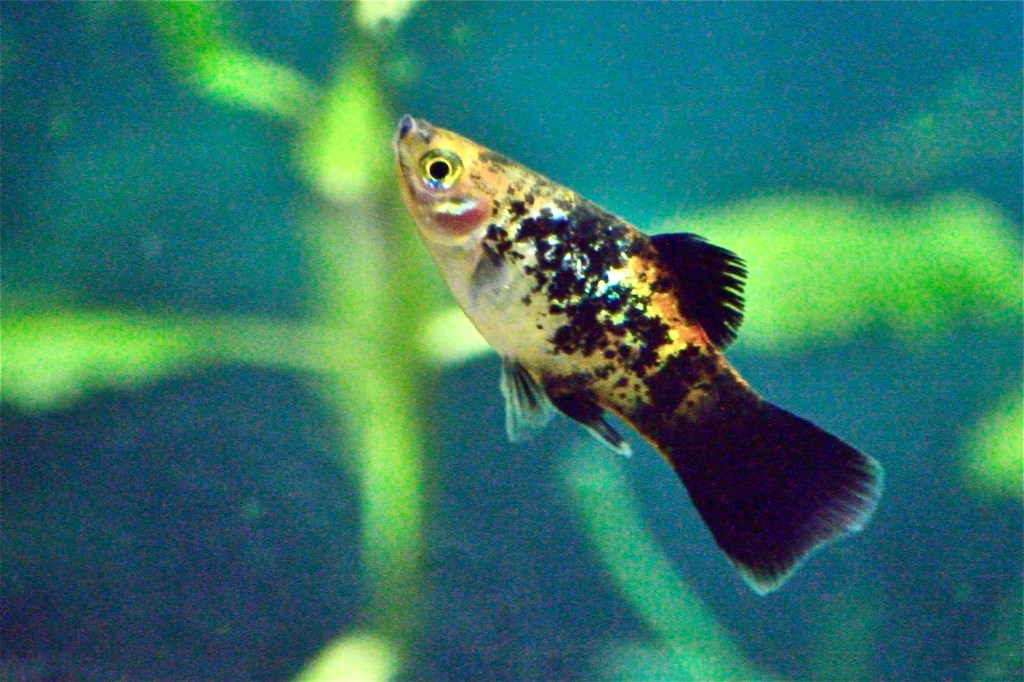
Platy (Xiphophorus maculatus)
Platies are one of my favorite species of aquarium fish. They come in all sorts of colors, are hardy and peaceful, and are delightfully chunky. If you like the color of goldfish but do not have the space for a 10-inch pooping machine, consider some sunburst or red wag platies for the same vibrance and insatiable hunger in a smaller package.
- Minimum tank size: 10 gallons (40 L)
- Temperature range: 70-82°F (~21-28°C)
- Max Size: 3 inches (7.6 cm)
- Temperament: peaceful
- Social Needs: groups of 3+
Swordtail (Xiphophorus hellerii)
Swordtails get their name from the long tail extension developed by mature males (and sometimes older females). The “sword” extends from the bottom corner of the tail, often thicker and darker than the rest of the fin. Swordtails are also very closely related to platies, and the two can crossbreed to produce healthy offspring.
- Minimum tank size: 20 gallons (~80 L)
- Temperature range: 70-82°F (~21-28°C)
- Max Size: 6 inches (~15 cm)
- Temperament: peaceful
- Social Needs: groups of 3+
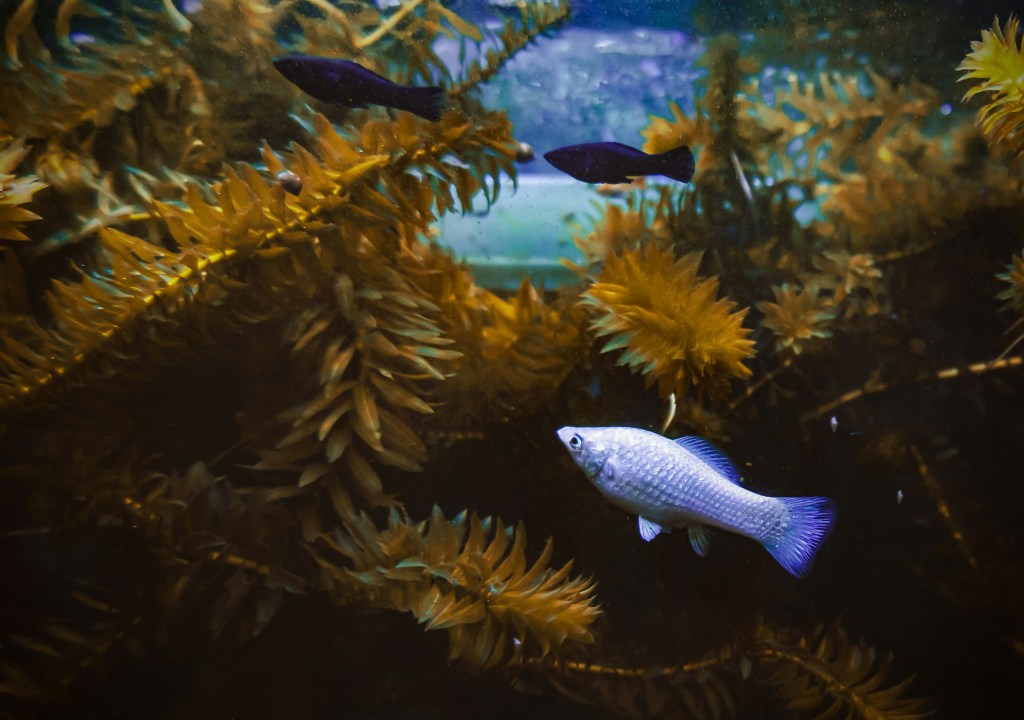
Molly (Poecilia sp.)
Mollies are closely related to guppies and Endler’s livebearers, but they get a bit larger. There are many different species of mollies, from the short and stubby balloon mollies ( to the large, magnificent sailfin mollies. While I recommend at least a 20 gallon for standard mollies, some of the larger varieties like sailfins will benefit from an even bigger tank. With mollies, it is especially important that you have at least three individuals in a group, because they can sometimes be bigger bullies than other livebearers.
- Minimum tank size: 20 gallons (~80 L)
- Temperature range: 72-82°F (~22-28°C)
- Max Size: 4.5 inches (~11.4 cm)
- Temperament: peaceful
- Social Needs: groups of 3+
Best Bottom Feeders and Algae Eaters for Beginners
The following are beginner-friendly species that will help keep the tank clean. However, owning these species will not replace tank maintenance. They can help you control algae and uneaten food, but you will still have to perform water changes, vacuum your gravel, and take steps to keep algae in check. Most importantly, you still need to feed your clean-up crew. While they will munch on leftover food and algae, you should supplement with sinking pellets and algae wafers to make sure they are getting enough.
It is important to note that no fish eats poop, and your “cleaner” fish will poop, too.
With that being said, the following species are still great additions to your aquarium and can be very fun to watch!
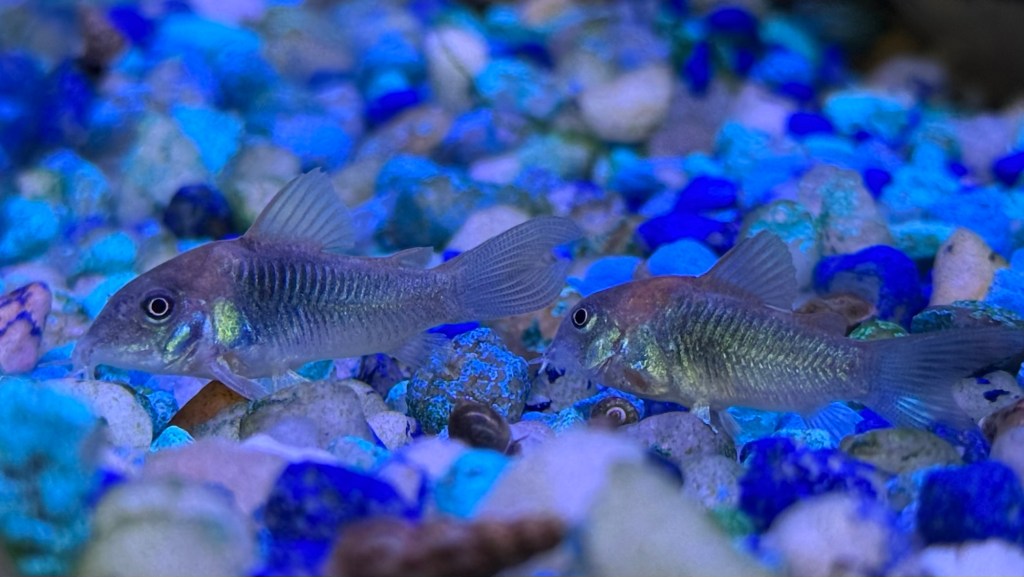
Corydora Catfish (Corydoras sp.)
Many fish keepers refuse to keep a tank without some sort of Corydora catfish snuffling about on the bottom of the aquarium. These silly and peaceful little guys are a schooling species and should be kept in groups of at least six. They will eat any food that falls to the bottom of the tank, but they do not eat poop. You should supplement your cories with some sinking bottom feeder pellets to make sure they get enough food!
- Minimum tank size: 10 gallons (~40L) for dwarf; 20 gallons (~80 L) for standard
- Temperature range: generally 70-80°F (~21-27°C); species dependent
- Max Size: 3 inches (7.6 cm); species dependent
- Temperament: peaceful
- Social Needs: schooling (6+)
Bristlenose Plecostomus (Ancistrus cirrhosus)
There are many methods for controlling algae in a fish tank, but many fish keepers opt to get an algae-eating fish, too. Many people gravitate toward the common plecostomus, not realizing that they can get to be two feet long! The bristlenose pleco is a smaller and better alternative for most tanks. They get their name from the bushy growths that appear on the noses of mature males. While they leave other fish alone, males can be territorial with one another. I recommend 20 gallons per fish to give each fish its own space, but also to keep your tank from being overwhelmed by pleco poop!
- Minimum tank size: 20 gallons (~40 L) per fish
- Temperature range: 72-82°F (~22-28°C)
- Max Size: 6 inches (~15 cm)
- Temperament: peaceful; males can be territorial toward each other
- Social Needs: solitary or in male/female pairs
Nerite Snail (various species)
Never underestimate the power of a snail. Nerite snails come in various sizes and colors, get along with just about any fish, and do a fantastic job at eating algae! When I was in college, I kept a betta tank on my desk. I left the lights on for at least 16 hours per day (I didn’t get much sleep), but the tiny horned nerite snail in the tank made sure I never had to clean any algae myself. The best thing about nerite snails is that they don’t reproduce in freshwater! That’s right! You can experience the unbridled joy of being a snail parent without worrying about its offspring overrunning your aquarium.
- Minimum tank size: 5 gallons (~20 L)
- Temperature range: 70-80°F (~21-27°C)
- Max Size: around 1.5 inches (~4 cm); species dependent
- Temperament: peaceful
- Social Needs: literally does not care

Frequently Asked Questions
Wondering why a species wasn’t included? Check out our frequently asked questions below!
Are goldfish good for beginners?
While goldfish are very hardy and are forgiving toward many beginner mistakes, they need far more space than people realize, with some experts suggesting 20-40 gallons per fish, depending on the breed. Your little fair goldfish can grow to over 8 inches long, and keeping them in a small tank will shorten their lifespan (which is 10-20 years, by the way). Goldfish are also very messy and need very good filters. Their large size and tendency to be absolutely disgusting make them a poor choice for your beginner aquarium (unless it’s, like, 40 gallons).
Are shrimp good for beginners?
While some shrimp, like Amano (Caridina multidentata) and cherry shrimp (Neocaridina davidi), are relatively easy to take care of, you have to choose tank mates very carefully, and shrimp are generally pretty sensitive to changes in water chemistry. They like stable, established tanks. Shrimp owners have to keep an eye on the amount of minerals present in the water to prevent fatal molting issues. Due to the advanced nature of setting up a shrimp tank, I have excluded shrimp from this list, although they are one of the most low-maintenance aquatic pets you can have once their tank is set up properly.
Why are neon tetras not good for beginners?
Neon tetras are one of the most popular fish for freshwater aquariums. However, despite their wide availability, they are surprisingly sensitive. They also have a disease named after them–Neon Tetra Disease. It is highly contagious, and there is no cure. They do best in stable, established setups after a quarantine period. Their sensitivity to sudden change and susceptibility to disease disqualify them from being beginner-friendly aquarium fish.
Why are otocinclus not good for beginners?
Otocinclus (aka otos or “dwarf sucker mouth catfish”) are small, schooling, algae-eating catfish that only get to be about 2 inches (5 cm) long. Because of their small size, they seem like a great algae eater for smaller tanks. However, many otos are wild-caught. They need very stable, established tanks, and they can be very picky with their food. Many will not touch commercial foods like algae wafers. They exclusively eat algae and biofilm (that slimy stuff that covers surfaces in established tanks). Because of their sensitivity to changes in water parameters and their pickiness with their food, I have excluded them from this list.
Conclusion
Beginner-friendly fish come in all shapes, sizes, and temperaments. Whether you want to start small with a single betta fish or dive right into keeping a school of zebra danios, there is a hardy fish for you! While these are fish that are easy to take care of, they still require care and attention from their keepers.
Regardless of the species you choose, make sure to do plenty of research to understand its needs. By consulting your local fish store employees, online forums, and blogs like this one, you can set yourself and your fishies up for success.
Happy fishkeeping!
 The Nature Corner
Leave a comment